
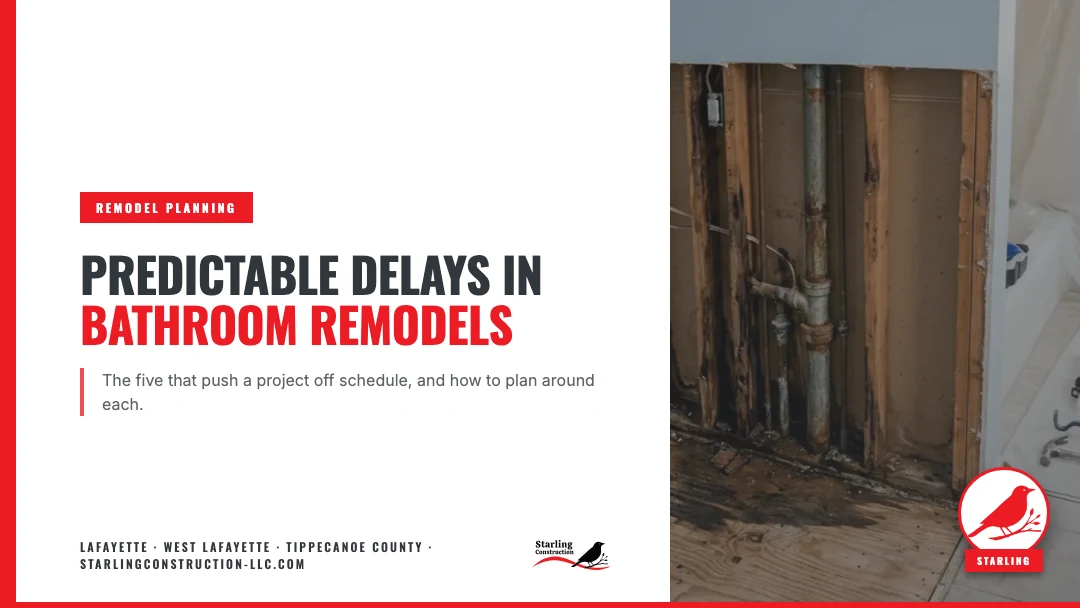
Quick Answer: Most bathroom remodel delays are predictable, which is exactly why they are preventable. The big five are long material lead times, permit and inspection scheduling, hidden damage found during demolition, mid-project change orders, and trade scheduling. The single most effective fix is finalizing every selection before demolition begins, so the project runs on decisions already made instead of stalling to make them.
Why does a bathroom remodel that was supposed to take a month end up taking three? It is the question that makes homeowners nervous before they even start. The reassuring answer is that a remodel rarely runs long because of bad luck. It runs long because of a short list of predictable causes, and predictable causes can be planned around.
A typical bathroom remodel runs about three to eight weeks, with a full gut taking longer, but that clock only holds if the decisions and materials are ready when the crew is. Starling Construction has walked Lafayette and West Lafayette homeowners through this enough times to know exactly where projects stall. This guide names the five delays that matter and shows how to beat each one before demo day.
Planning a bathroom project and want a timeline you can trust? Get a free quote, or call 765-237-9420.
The most common reason a remodel stalls has nothing to do with the crew. It is a box that has not arrived yet.
Special-order items carry real lead times, and they are longer than most homeowners expect. Custom cabinetry and vanities commonly run 8 to 16 weeks, a custom glass shower enclosure 2 to 5 weeks, and specialty or imported tile several weeks versus a week or two for stock. A glass enclosure adds a twist: it often cannot even be measured until the tile is set, so its clock starts partway through the job.
The fix is order-early, not order-when-needed. The National Kitchen and Bath Association is direct about this in its planning guidance, advising homeowners to make product decisions early to avoid delays from material shortages and backorders. When the vanity, tile, fixtures, and glass are chosen and on order before demolition starts, the long lead times run in the background instead of stopping the job cold. This is one reason our bathroom remodel investment tiers guide pushes selections to the front of the process.
The second predictable delay is administrative, and it catches people who assume a bathroom is too small to need paperwork.
In the Lafayette area, permits are issued by the Tippecanoe County Building Commission for the unincorporated county, while City of Lafayette residents apply through the city. As a rule of thumb, moving or adding plumbing or electrical triggers a permit, while a simple like-for-like fixture swap in the same spot often does not. Because the exact threshold varies, it is worth confirming with your local office before work begins, which is a step a good contractor handles for you.
Inspections are the piece that stretches the calendar. Work has to pause at set points, such as after rough-in, until an inspector signs off, and inspections run on the municipality’s schedule, not yours. A contractor who books those windows in advance and sequences the trades around them keeps the pauses short instead of letting them balloon into lost weeks.
The third delay is the one no one can see coming until demolition starts. It is also the most common source of a genuine surprise.
Until the old tile and vanity come out, no one knows for certain what is behind them. Demolition routinely reveals water damage, rot under a tub, outdated or unsafe wiring, corroded or undersized plumbing, and framing that was never quite to code. There is no reliable published figure for how often remodels uncover surprises, but the reason it happens so often is well documented: the National Association of Home Builders reports in its 2025 housing-stock analysis that the median owner-occupied U.S. home reached 42 years old in 2024, and that nearly half were built before 1980. Older homes hide older systems.
You cannot fully prevent this one, but you can plan for it. A realistic project builds in a contingency of both time and budget for what demolition might reveal, and a contractor who inspects thoroughly beforehand narrows the odds of a major surprise. Hidden conditions are common in older homes, which is why a thorough pre-project walkthrough is part of our bathroom remodeling process. Planning for the possibility turns a project-stopping shock into a manageable line item.
The fourth delay is self-inflicted, and it is the easiest to control. It happens when decisions are still being made after the work has started.
A change order is any change to the plan once construction is underway: switching the tile after seeing it on the wall, moving the vanity, adding a niche, upgrading the fixtures. Each one can mean re-ordering materials, redoing work, and re-sequencing trades, and each one adds time. The later the change, the more expensive and disruptive it is.
The prevention is the same discipline that beats lead times: decide before demo. When the full scope and every selection are locked before the first wall opens, there is nothing left to change mid-project. A detailed pre-construction plan is not bureaucracy. It is the tool that keeps the job moving in one direction.
The fifth delay is about sequence. A bathroom remodel is a relay of specialists, and the handoffs have to line up.
Demolition, plumbing, electrical, tile, glass, and finish work each need the right trade at the right time, and each depends on the step before it being done and often inspected. If a plumber is booked out two weeks when the job is ready for rough-in, everything behind that step waits. On a small footprint like a bathroom, only one trade can usually work at a time, so a single gap in the schedule stalls the whole project.
This is where an experienced general contractor earns the fee. Coordinating the trades, holding the sequence, and keeping the next specialist lined up is the daily work that keeps a remodel on track. The industry reflects this: coverage of the 2025 Houzz Bathroom Trends Study by Qualified Remodeler reports that 84 percent of homeowners hire a professional for their bathroom renovation, with a general contractor the most common choice. Managing the schedule is a big part of why.
Read back through the five, and a single theme runs under four of them: decisions made too late. That points to one habit that prevents most remodel delays.
Finalize every selection before demolition begins. Tile, vanity, fixtures, paint, glass, hardware, layout, all of it decided and ordered before the first wall opens. It removes change orders, it lets long lead times run before they can stall the job, and it lets the contractor build a trade schedule that actually holds.
| Delay | Root cause | The fix |
|---|---|---|
| Material lead times | Ordering special items too late | Choose and order everything before demo |
| Permits and inspections | Underestimating the approval clock | Confirm requirements early; book inspections ahead |
| Hidden damage | Unknown conditions in older homes | Build in a time and budget contingency |
| Change orders | Deciding after work has started | Lock the full scope before demo |
| Trade scheduling | Trades not lined up in sequence | Hire a GC to coordinate the relay |
The NKBA points at the same lever in its planning guidance: decide early and the rest of the project has room to run smoothly. A remodel that starts with every choice made is a remodel that finishes close to schedule. If you want help building that plan for your space, our bathroom remodeling service starts with exactly that conversation.
These are the timeline questions Lafayette and West Lafayette homeowners ask most before starting a bathroom project. The short version is that delays are predictable and largely preventable with good planning. The answers below cover the specifics.
A typical bathroom remodel runs about three to eight weeks of active work, with a full gut or a custom master bath taking longer. The bigger variable is often what happens before the crew arrives, since material lead times and permit approvals can add weeks if they are not handled up front.
The most common cause is material lead times, especially on custom vanities and glass shower enclosures. After that come permit and inspection scheduling, hidden damage found during demolition, mid-project change orders, and trade scheduling. Four of the five trace back to decisions or orders made too late.
Usually yes if the work moves or adds plumbing or electrical, and often no for a simple like-for-like fixture swap. Permits are issued by the Tippecanoe County Building Commission or, for city residents, the City of Lafayette. Because the threshold varies, confirm with your local office first, or use a contractor who handles permitting.
You cannot prevent hidden damage entirely, since no one sees behind the walls until demolition. With the median U.S. home now 42 years old, older plumbing and wiring are common finds. The fix is planning for it: build a time and budget contingency, and work with a contractor who inspects thoroughly before starting.
Finalize every selection before demolition begins. Choosing and ordering the tile, vanity, fixtures, and glass up front removes change orders, lets long lead times run in the background, and lets the contractor build a trade schedule that holds. The NKBA specifically recommends making product decisions early to avoid delays.
A bathroom remodel is a relay of trades that must run in the right order, and each handoff depends on the step before it. A general contractor coordinates demolition, plumbing, electrical, tile, and finish work, books inspections ahead, and keeps the next trade lined up. That scheduling is a major reason most homeowners hire a professional rather than manage it themselves.
A remodel that starts with every decision made is a remodel that finishes on time.
Starling Construction plans Lafayette and West Lafayette bathroom projects around the delays before they happen: selections locked, permits confirmed, hidden conditions accounted for, and the trades sequenced. You get a timeline built on decisions already made, not guesses.