
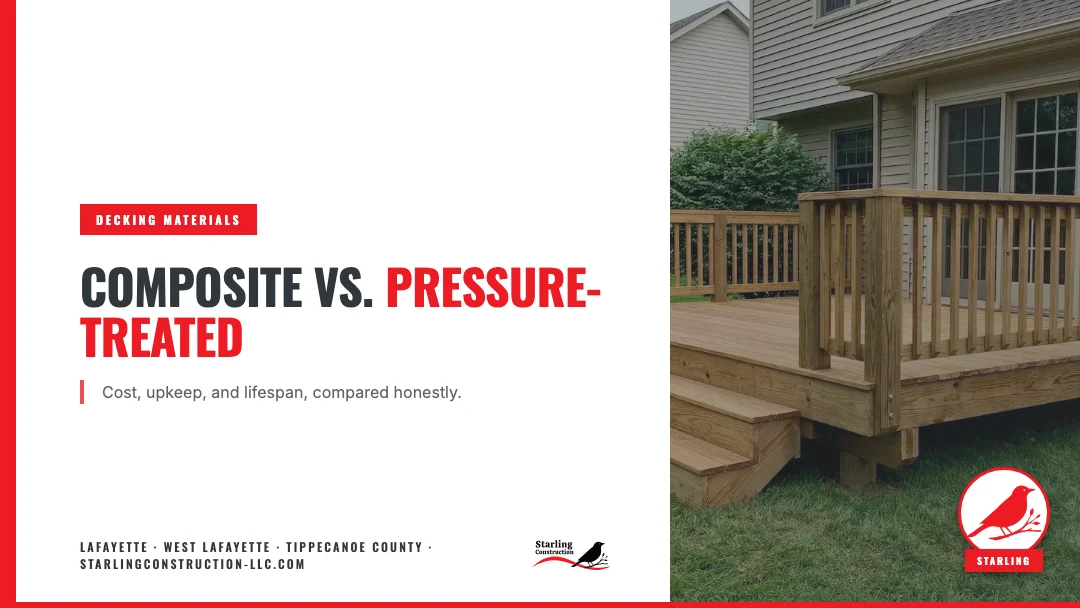
Quick answer: Pick pressure-treated wood if you want the lowest upfront price and you do not mind sealing or staining it every couple of years. Pick composite if you want to pay more once and then spend almost no time or money on upkeep for decades. The real tradeoff is simple: lower install cost now versus lower maintenance later.
In Lafayette and West Lafayette, a deck takes a beating you might not expect. Indiana hands you humid summers, hard freezes, spring rain, and stretches of strong afternoon sun. All of that works on a deck year after year. The material you choose decides how many weekends you spend fighting that weather and how the deck looks a decade from now.
Pressure-treated lumber is real wood treated with preservatives to resist rot and insects, while composite is a manufactured board made from wood fibers and plastic. That single difference drives everything else: price, upkeep, lifespan, and how each one ages.
Wood gives you a natural grain and a lower price, but it moves with the weather. Without upkeep it can crack, warp, splinter, and fade. Composite holds its color and shrugs off rot, insects, and splintering. The catch is the higher sticker price, and darker composite boards can get hot underfoot in direct summer sun.
If you are still deciding between a deck and a hard surface entirely, our deck versus patio comparison for Lafayette walks through that earlier fork in the road.
A pressure-treated deck typically installs for $5,000 to $16,000 on a roughly 200 square foot footprint, while a composite deck runs about $12,000 to $24,000 on a larger 400 square foot build. On a per square foot basis, expect $25 to $50 for pressure-treated and $40 to $75 for composite, installed.
Those are national ranges. Because labor in the Lafayette area runs below big-metro rates, local jobs tend to land toward the lower-to-middle of each range. Here is how the two materials compare across the points that matter most.
| Factor | Pressure-Treated Wood | Composite |
|---|---|---|
| Installed cost (typical) | $5,000 to $16,000 | $12,000 to $24,000 |
| Cost per square foot | $25 to $50 | $40 to $75 |
| Maintenance | Clean and re-seal or stain every 2 to 3 years | Occasional wash with soap and water |
| Lifespan | About 15 to 20 years with upkeep | About 25 to 30+ years |
| Looks and feel | Real wood grain, natural look, can fade | Holds color, resists splinters |
| Heat in sun | Stays cooler | Darker boards can get hot |
| Resale | Usually recoups a bit more | Strong appeal for low-maintenance buyers |
For a fuller picture of where decks fit in your overall budget, see our outdoor living cost guide for Lafayette.
Pressure-treated wood asks for steady attention, while composite asks for almost none. That gap is the single biggest reason homeowners change their minds about which material they want.
With wood, plan to clean the deck and re-seal or stain it roughly every 2 to 3 years. Skip those rounds and the boards fade, gray out, and start to crack or splinter. That upkeep costs you both time and the price of stain and sealer every cycle.
Composite is closer to set-and-forget. A wash with soap and water a couple of times a season keeps it looking right. No sanding, no staining, no sealing. For families who would rather use the deck than service it, that difference adds up fast.
Composite outlasts pressure-treated wood by a wide margin. A well-kept wood deck runs about 15 to 20 years, while composite commonly reaches 25 to 30 years or more.
Composite also tends to come with long manufacturer warranties, frequently 25 years or longer, which is a kind of insurance you do not get with a stack of treated lumber. Wood can hit the top of its range, but only with the regular sealing and staining described above. Let it go and that lifespan shrinks.
Wood looks like wood because it is wood: warm grain, natural tone, the real thing. Composite mimics that look well and keeps it consistent for years, since it does not fade or weather the way lumber does.
The feel underfoot differs too. Wood stays cooler in direct sun, which matters on a south-facing deck during a Lafayette July. Darker composite boards can heat up in full sun, so lighter composite colors or some afternoon shade help. Composite also will not splinter, which is a real plus for bare feet and small kids.

Look past the install price and the math shifts. Composite costs more up front but asks for far less time and money over its life. Pressure-treated wood is cheaper to build but you pay it back in maintenance hours and the cost of stain and sealer, cycle after cycle.
Think of it as paying now or paying later. A wood deck spreads its cost across years of upkeep, while a composite deck front-loads the cost and then mostly leaves you alone. Over 20 years, those repeated sealing rounds close a good part of the upfront gap.
Planning that long view is exactly what keeps a project on track. Our notes on avoiding budget drift on a remodel cover how to weigh first-year cost against the years that follow.
Outdoor living holds its value well, and a deck addition ranks among the higher-returning remodeling projects nationally, as the industry’s annual Cost vs. Value Report tracks year after year. Either material adds usable square footage that buyers notice.
Between the two, wood decks typically recoup a bit more of their cost at resale than composite. That said, composite carries strong appeal for buyers who do not want to inherit a maintenance chore. The right pick at resale depends on the kind of buyer your neighborhood draws.
There is no single right answer, only the right answer for how you want to live with the deck. Here are honest scenarios for each.
Choose pressure-treated wood if you want the lowest upfront price, you like the look of real lumber, and you are willing to clean and re-seal it every couple of years. It is also a sound pick if you expect to move within a decade and want to spend less now.
Choose composite if you want to build once and stop thinking about upkeep, you plan to stay long enough to bank those saved maintenance hours, or you simply do not want to spend weekends staining a deck. The higher upfront cost buys you decades of low effort.
Both materials need the same Tippecanoe County deck permit, so material choice does not change your paperwork. If you are mapping out the full build, our guide on how long it takes to build a deck in Indiana and our decks service page lay out the next steps.
Homeowners across Tippecanoe County tend to ask the same handful of questions before they commit to a material. Here are straight answers.
It depends on how long you will own the home and how much you value your time. Composite costs more up front, but it asks for almost no upkeep over a lifespan of 25 to 30+ years. If you plan to stay and you dislike maintenance, the higher cost usually pays off.
Plan to clean and re-seal or stain it roughly every 2 to 3 years. The exact timing depends on sun exposure and weather, both of which are real factors in Indiana. Skipping these rounds leads to fading, cracking, and splintering, which shortens the deck’s life.
Darker composite boards can get hot in direct summer sun. Lighter composite colors absorb less heat, and a south-facing deck benefits from some afternoon shade. Pressure-treated wood stays cooler underfoot, which is worth weighing if your deck sits in full sun.
Composite lasts longer, commonly 25 to 30 years or more, and it often carries a manufacturer warranty of 25 years or longer. A pressure-treated wood deck lasts about 15 to 20 years, but only with regular cleaning and re-sealing. Neglected wood wears out sooner.
No. Both materials need the same Tippecanoe County deck permit. The permit is based on the deck structure, not the surface material, so your choice between composite and pressure-treated wood does not change the paperwork or the inspection.
A pressure-treated deck typically installs for $5,000 to $16,000, and a composite deck for $12,000 to $24,000, depending on size and design. Because local labor runs below big-metro rates, Lafayette jobs often land toward the lower-to-middle of those ranges.
Ready to pick the right decking for your home?
We will give you honest cost ranges for both composite and pressure-treated wood, with no surprises. Call (765) 237-9420 to talk through decking options.